About
Welcome
Welcome to the Goju-Ryu Karate Dojo. As my Sensei welcomed me, I welcome you to your first steps and movements in the world of Goju-Ryu Karate. To some people Karate is combat. To others, it is primarily for show. There are dozens of other approaches ranging from religion or a teaching device to physical fitness or self-defence. However you choose to define it, the art of karate has endless dimensions. Karate is mental and physical, artistic and grotesque, practical and non-practical, violent and graceful, and so much more. Goju-Ryu Karate is subjective, incomplete, and is constantly changing. It is impossible to fully comprehend the entirety of Karate, but here at Goju-Ryu Karate Dojo we will learn as much as we can.
Many years ago Japanese Chojun Miyagi studied Karate in Okinawa. From his studies he developed the style of Goju-Ryu Karate, and returned to Japan to teach it. From this beginning, Goju-Ryu Karate has developed into the most popular form throughout the world. This form of karate has over 3,000,000 adherents as it is something anyone can find use in.
While Goju-Ryu Karate includes many of the basic movements of other fighting arts, it is unique in many aspects. Particularly in the basic Katas, or movements which must be learnt thoroughly to understand and successfully practice this style. These movements begin simple and as the student progresses through the various levels of this course, they will learn more complicated and intense Katas that form a crucial part of Goju-Ryu Karate.
The combination of these movements and the other special facets of Goju-Ryu Karate will teach students discipline, self-defence, and self-confidence, and physical fitness.
History
Goju-Ryu Karate-Do is a mixture of Chinese martial arts and traditional martial arts in Ryukyu, which is now known as Okinawa (about 500 years ago). During the Ryukyu age, weapons were not allowed for any civilians because of the government's policy. These peasants who developed martial arts called Te, fought with barefoot and bare hands. In the process of spreading over Ryukyu, different kinds of martial arts were created, such as Naha-te, Shuri-te, and other Styles.
Kanryo Higaonna (1852-1915 ) was still in his teens when his father died. At the age of 14, he began his formal training in Chinese Kempo with Seisho Arakaki (1840-1920), who had studied the Fukien style. Kanryo decided he wanted to continue his studies in martial arts abroad and he set his heart on traveled to Fuzhou, China for this purpose. It is said that he visited the port city in 1873 for fifteen years. Some martial arts historians explain his motive for visiting the city was to study the Chinese Martial Arts. Higaonna did, in fact, study a Southern Shaolin Chaun style with Sifu (instructor) Liu Liu Gung and remained there for 15 years, during his stay in that city.
As explained by other historians, his initial reason for visiting China was the result of his political involvements. He arrived in Fuzhou in the year 1869, he was 15 or 16. It is believed that Higaonna Sensei also studied the styles of Hung Gar-Shaolin Chuan, hard style Chinese martial arts of Chi-Chi and/or I-Chi as well with another master named "Woo". He began his studies with Ryuruko in 1876 at the age of 23 in Fujian Province, China, and he remained there under the severe instruction of his teacher for approximately 13 years. After he came back to Ryukyu, he combined both techniques and created a new style called To-dei. This martial arts was the beginning of Karate.
During this transitional period of time when this martial art was becoming more popular in mainland Japan, it was called "Karate Kempou" which meant Chinese Hand Fist System. Later during 1930s Japanese practitioners changed the written kanji characters to Kara-te. The first word means "empty", and the second word means "hand". Its implication is to symbolize a pair of bare hands in combat for the sake of self-defense against the armed hands. However, it was a Japanese political attempt to transform the body of the art with metaphysical insinuation so that the name can eliminate its national identity.
Goju-Ryu which originated from Naha-te was established by Chojun Miyagi (1888-1953) who was a disciple of Kanryo Higaonna. At the age of 16, Chojun Miyagi went to China and studied Karate under many renowned Karate masters. He also studied theory and completed special breathing way called "Kisoku no Donto".
"Go" means "hard" and "ju" means "soft", thus idiom Goju suggests any variation of hard and soft aspect. As for a historical point of view a major body of system was imported from Fukien Province in China, which the system called itself one half hard and one soft style in Chinese. The system also called Fukien Crane Chuan which was branched school from Five Ancestor Chuan .
Karate-Do was named officially during the 1930's in mainland Japan. The interpretation of the word "Do" literally means "way" as for "a way of life". Traditionally, all the martial arts that were recognized among the field claimed their specific name of school or style in order to identify their lineage within the art. Unlike its custom, the art of Karate-Do in Okinawa thus started claim to its name of style such as Goju-Ryu and Shito-Ryu. The interpretation of the word "Ryu" literally means stream which indicates lineage of branch. Among the various styles of Karate originally practiced on the Okinawa island, Goju-Ryu is known as the earliest institute of Karate that named its school by its specific style.
In 1937, Gogen Yamaguchi , a student of Chojun Miyagi, promoted the school of Goju-Ryu Karate in Japan. In 1950, he founded the national organization of All Japan Karate-Do Goju-Kai in Tokyo, Japan. Gogen Yamaguchi has developed what we call "modern Karate". From a technical point of view, he had unified all Karate exercise by employing an extremely well organized method. As a result of the introduction of free-style sparring, the art of Karate had become a more active and popular art in Japan as well as in other parts of the world. Although he studied such martial arts as Judo, Kendo, Iaido, Jo-do, and Kusari -gama (art of chain) in his younger days, Karate had from the beginning captured most of his enthusiasm.
OUR CORE VALUES
OUR DOJO KUN (PLEDGE)
We will respect our parents, teachers, and elders.
We will not use our karate to harm others only for self-defense.
We will strive for the truth in everything we do and say.
We are proud of our dojo and being part of Karate Academy.
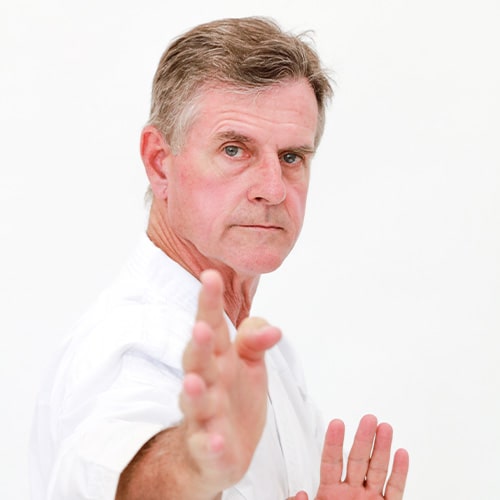
Glenn Stephenson, Kyoshi Shihan - Chief Instructor & President of Seiwakai in Australia
President and Chief Instructor for Goju Ryu Karate do Seiwakai Australia
Chief Instructor, Karate Academy of Japan Goju Ryu
Past President, JKF Gojukai Australia
7th Dan, Kyoshi Shihan, Gojuryu Karate do Seiwakai - August 2017 6th Dan, Renshi Shihan, JKF Gojukai - Oita Japan 2015
2nd Dan ,Okinawa Kobudo Federation
QUALIFIED (Fitness Australia) Personal Trainer, Cert 3 & 4, ACPE Academy
With more than 45 years of experience, Glenn has multiple titles under his belt. Over the years he has honed his on his skills to be able to teach what he has learned from his master to his students.
Started Karate 1979 with Karate Academy of Japan Goju, Ashfield under Keith Hill Shihan 5th Dan Gojuryu Karate do Seiwakai. Now, training directly under Seiichi Fujiwara Hanshi 8th Dan (Shuji Tasaki 9th Dan Hanshi RIP) of Gojuryu Karate do Seiwakai.
Glenn won a WKKF World Kata Bunkai Champion title in 1994 Tokyo, Japan. Now, Head Instructor for Gojuryu Karate do Seiwakai Australia teaches most nights, Through the All Japan Karate Federation Gojukai has trained under the best of Japans' JKF Goju Kai masters include Shiomi Shihan, Maiyama Shihan, Maigawa Shihan, Tada Shihan, Fujiwara Shihan, Tasaki Hanshi and Lipinski Shihan since 1989 has had regular trips to Japan has developed and honed the skills that have been taught to him. Goju Ryu develops close in fighting skills that other sports style karate fighters are looking for it has both Karate and Jutsu involvement with the higher Dan level techniques. To find a good coach is the key Shuji Tasaki Shihan was the best and Fujiwara Shihan has developed his coaching through the guidence of a great master that devoted his life to his love for Karate, I enjoy my Karate and like to invite others to train and learn from my experience.
Michael Patrick Renshi Shihan
Deputy Head Instructor Gojuryu Karate do Seiwakai Australia
Senior Instructor / Director of Karate Academy of Japan Goju Ryu
7th Dan in Goju Ryu Karate do Seiwakai - 2023 RENSHI
6th Dan All Japan Karate do Federation Gojukai - 2017
1st Dan Okinawa Kobudo Federation
Dojo Instructor for Campbelltown & Camden Area including, Rosemeadow Dojo, St Helens Park Dojo and NOW at Elderslie Dojo. Michael achieved a National Championship in The Australian Koshiki Cruiser Weight Division and has also achieved Two National Championship titles in Men's open Kata division in Koshiki
He was awarded his 4th Dan by Shihan Tasaki in Ibaraki near Tokyo after 8 days of training in Japan July 2007. has progressed to 5th Dan through the guidance of Coach and mentor Glenn Stephenson Shihan and was awarded his 5th Dan by Seiichi Fujiwara Hanshi in Australia March 2012 and in the same month passed his JKF Gojukai 5th Dan.
Michael is head of the technical committee for Gojuryu Seiwakai in Australia and deputises for Glenn Stephenson when overseas duties perivale.
Fareed Mills
Instructor Gojuryu Karate do Seiwakai Australia
4th Dan in Goju Ryu Karate do Seiwakai - 2016
4th Dan All Japan Karate do Federation Gojukai - 2017
Dojo Instructor for Rosemeadow Dojo Fareed has been training since 1983 at the age of 10 years old under the guidence of Glenn Stephenson. He does not like tournament style Kumite although love a challenge in dojo kumite.
Fared has travelled to Japan multiple times to further his knowledge, he has over 30 years experience with Karate.
Fareed has travelled with Glenn Stephenson Shihan to Japan on two occasions Tokyo in 1999 & Osaka in 2007.
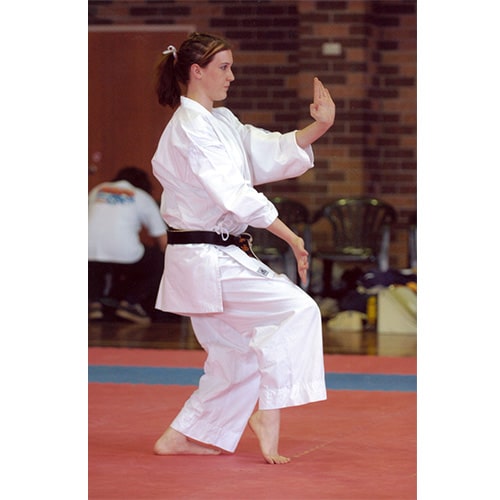
Kylie Stephenson Sensei
Instructor for Goju Ryu Karate do Seiwakai Australia
Instructor, Karate Academy of Japan Goju Ryu Rosemeadow Dojo
4th Dan, Gojuryu Karate do Seiwakai - 2021
4th Dan, All Japan Karate do Federation Gojukai - 2021
2nd Kyu ,Okinawa Kobudo Federation - 1998
Kylie Sensei runs Picton Dojo has a renewed passion for Karate and it shows when she is teaching.
Started Karate 1990 with Karate Academy of Japan Goju, Rosemeadow Dojo under the guidance of her father Glenn Stephenson & Keith Hill Shihan 5th Dan Gojuryu Karate do Seiwakai. Now, training directly under Shuji Tasaki 9th Dan Hanshi of Gojuryu Karate do Seiwakai.
Kylie was National Champion and Australian Open Champion she has won a number of national and international events, in AKF and JKFG as a mum she knows that post natal training can be important to returning to your pre baby body.
Shawn started his Karate journey in 1985, training in an Okinawan style Gojuryu Karate for a number of years, and then trained in Krav Maga for a number of years including 4 annual trips to Israel to train with Israeli masters. His passion for Goju Ryu pulled him back to Karate and he transferred to the Nth Sydney Gojuryu Karate do Seiwakai dojo where he trained and developed under Glenn Stephenson Shihan. He has traveled with Glenn Stephenson Shihan to Japan a number of times and has increased his knowledge through Stacey Karetsian Shihan 7th Dan (Australia) and Fujiwara Hanshi 8th Dan (Japan). His focus is on training and teaching pragmatic self-defence, and is a great supporter of development of the youth.
North Shore training times:
- Age 5 to 9: Tue 6:00pm & Thu 6:00pm
- Age 10 to adult Tue 7:00pm & Thu 7:00pm
Eastern Suburbs training times:
- Wed 6:30pm
Andrew Jeney
Instructor Gojuryu Karate do Seiwakai Australia
4th Dan - Goju Ryu Karate do Seiwakai - 2017
4th Dan - All Japan Karate do Federation Gojukai - 2020
Dojo Instructor for Glebe Dojo Andrew first started training in the 80s under Keith Hill Shihan 5th Dan, due to family commitments gave it up only to start back in 2008 and has been training ever since. Tested successfully for 1st Dan and then in March traveled to Brisbane to test for JKF Gojukai 1st Dan. Now runs the Ashfield Dojo.
Andrew has developed great students that are developing at a rapid rate.
Phil Gibson
Instructor - KAJ Gojuryu Karate do Seiwakai
3rd Dan- KAJ Gojuryu Karate do 2019
2nd Dan Goju Ryu Karate do Seiwakai - 2009
2nd Dan Dan JKF Gojukai - 2011
1Dan Okinawa Kobudo
Phil joined Goju Ryu Karate do Seiwakai in 2007 and co runs the Penrith Dojo with Glenn Stephenson Shihan he is a hard worker and loves his karate training. Phil Sensei also does Matoshi Kobudo where his enthusiasm has been passed on to the students.
Davy Wijaya
3rd Dan Sensei
Karate Academy Werrington
3rd Dan Goju Ryu Karate do Seiwakai - 2022
3rd Dan All Japan Karate do Federation Goju Kai - 2023
Instructor - Werrington Dojo
Karate Academy Goju Ryu Werrington
Having started his karate with GKR in 1993 and graded to Black Belt in 1998 when he was 18yrs old. Wanted to pursue his passion for Goju Ryu Karate he travelled to Okinawa Japan in 2018 to learn from the karate masters. Then he discovered Goshukan Karate Academy a Gojuryu style and trained under Stacey Karetsian Shihan 7th Dan. Davy has travel to Japan to further his knowledge under Fujiwara Hanshi 8th Dan. He expands his knowledge under Goshukan Karate Academy in the style on Gojuryu at St Marys and Werrington area from 2019. He is now continuing his karate of Gojuryu under the guidance, support and mentor by Glenn Stephenson Shihan 7th Dan, Director of Gojuryu Karate do Seiwakai Oceana. He is a family man that trains karate with his beautiful wife Dina and 4 lovely children’s.
2021 Kata national champion JKF Goju Kai.
2022 Kata national champion JKF Goju Kai.
2022 Kata national champion Goju Ryu Cup.
2023 Kata national champion JKF Goju Kai.
Werrington Dojo
Arthur Neave Memorial Hall.
43 Parkes Avenue,
Werrington 2747
training times:
Monday & Thursday classes
Little Ninja Class (4-6yrs) 5:15 - 5:45pm
Karate Kids Class (7-8yrs) 6 - 6.45pm
Teens to Adults Class (9yrs+) 7 - 8pm
High grades (Advanced Class) 8 - 8:30pm

Gordon Kane
2nd Dan Dan JKF Gojukai - 2019
Joined Goju Ryu Karate do Seiwakai in 2006
Training 20 years, having started his journey with
GKR. NEEDED A CHALLENGE for something more and discovered IGK, run by Tino
Ceberano Hanchi and changed to Goju Kai. Was with IGK for a few years
untill instructor could not continue for family reasons and the dojo
was taken over by Seiwakai Australia with Iyan Mackenzie Shihan as our
instructor. Found it challenging but rewarding, have been with Karate Academy(Seiwakai Australia) ever since and have travelled to
and trained in Omaragi. Japan. and hope to go back again soon.
Has graded to 3rd Dan Goju Ryu Karate Do Seiwakai in 2019 and also to 2nd
Dan Japan Karate Federation Goju Kai in 2019. Train directly under
Glenn Stephenson Shihan and also train with Rod Martin Shihan as much as
possible to keep up with trends and training updates
Ryal Rosen
5th Dan
Ryal started Karate in 1984 with Karate Zen in South Africa.
He attained Provincial All styles colours and Gold medals as a junior and Senior for Kata and Kumite at provincial level.
He was a member of Shihankai SA and a member of the senior executive and provided valuable leadership to South African karate before migrating to Australia
Graded 5th Dan April 2018.
Ryan was coach and instructor to some of South Africa most prolific junior and senior athletes over the past two decades.
Classes:
- KEYSBOROUGH Gardens Primary School, 10 Homeleigh Road, Keysborough Victoria 3173
- Contact: Ryal Rosen 0450 445 900
- Hours: Monday and Friday 6pm to 7pm